Culture Stack
2025—26 · Founder, design, buildCan you see your cultural fit with a company before you commit?
Culture Stack is based on a simple question: can you see your cultural fit with a company before you commit? And going further, can you assess it without having to take a test?
The short answer to both is: yes. You absolutely can.
While that sadly didn’t materialize into PMF, the whole undertaking was a journey of solving one difficult problem after another.
The idea started as a personal problem. At a previous job, I experienced being a severe cultural misfit. Serendipitously, I stumbled across Erin Meyer’s The Culture Map (a classic!). That was a true eye-opener. As a long-time listener and fan of Adam Grant’s WorkLife podcast (before it turned shit) and a reader of organizational psychology papers, I found myself in disbelief: it’s the culture, stupid! How did I not see that?
I spent five months going deep into the literature and created my own cultural assessment framework, based on observable behavior. Then a good couple of months operationalizing it. I was driven. Only if I could get test-grade results without asking users to fill in a questionnaire would I call it a product.
And so I did.
I won’t reveal the secret sauce of the engine I created. But simply put: it derives cultural friction potential from what is already written down, a company’s public trace and a person’s CV.
- Mar 11Start
First commit. After five months in the literature, the framework goes into code.
- Mar 29Identity
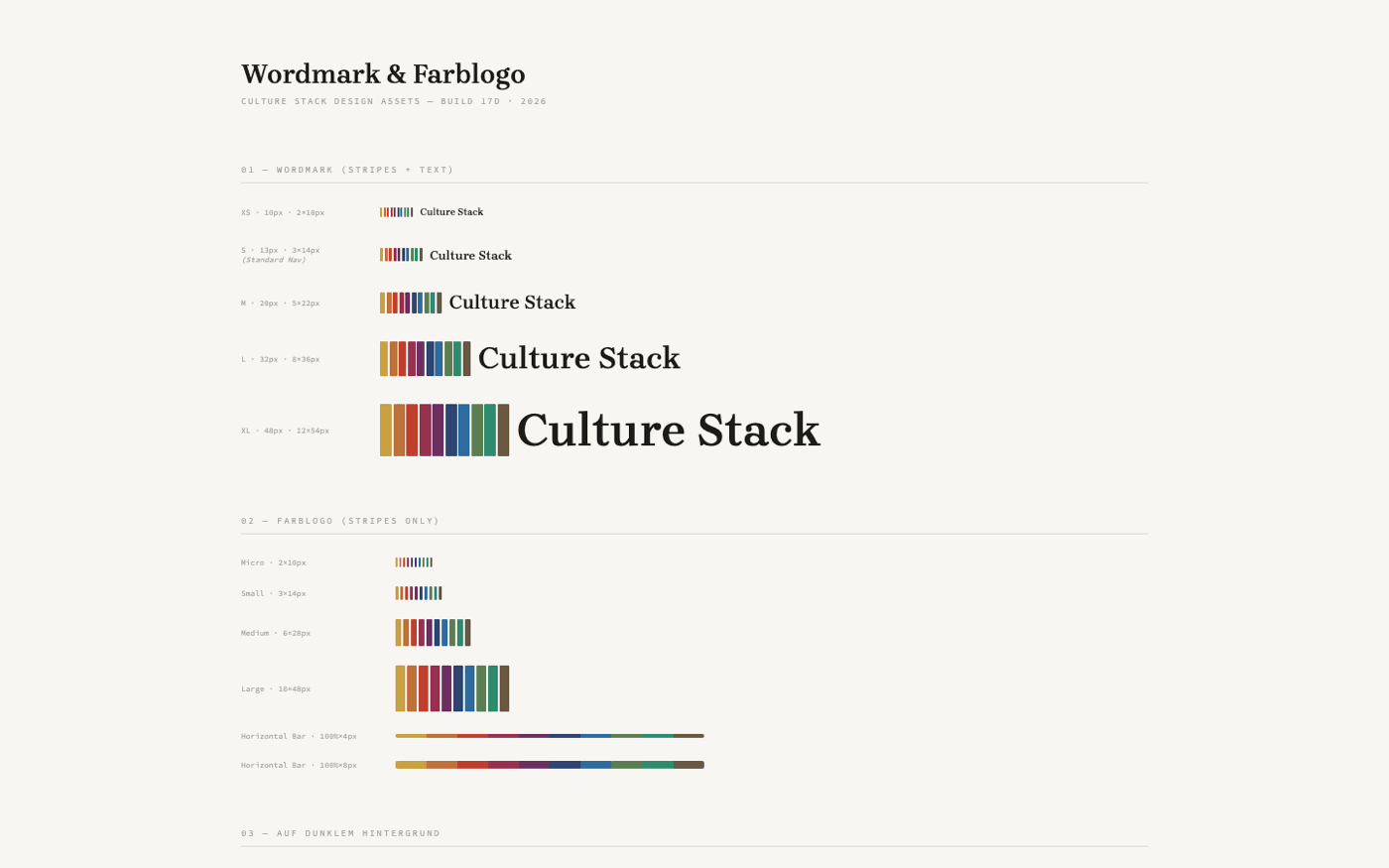
Ten stripes. One coloured stripe for each of the ten dimensions.
- Apr 12Brand
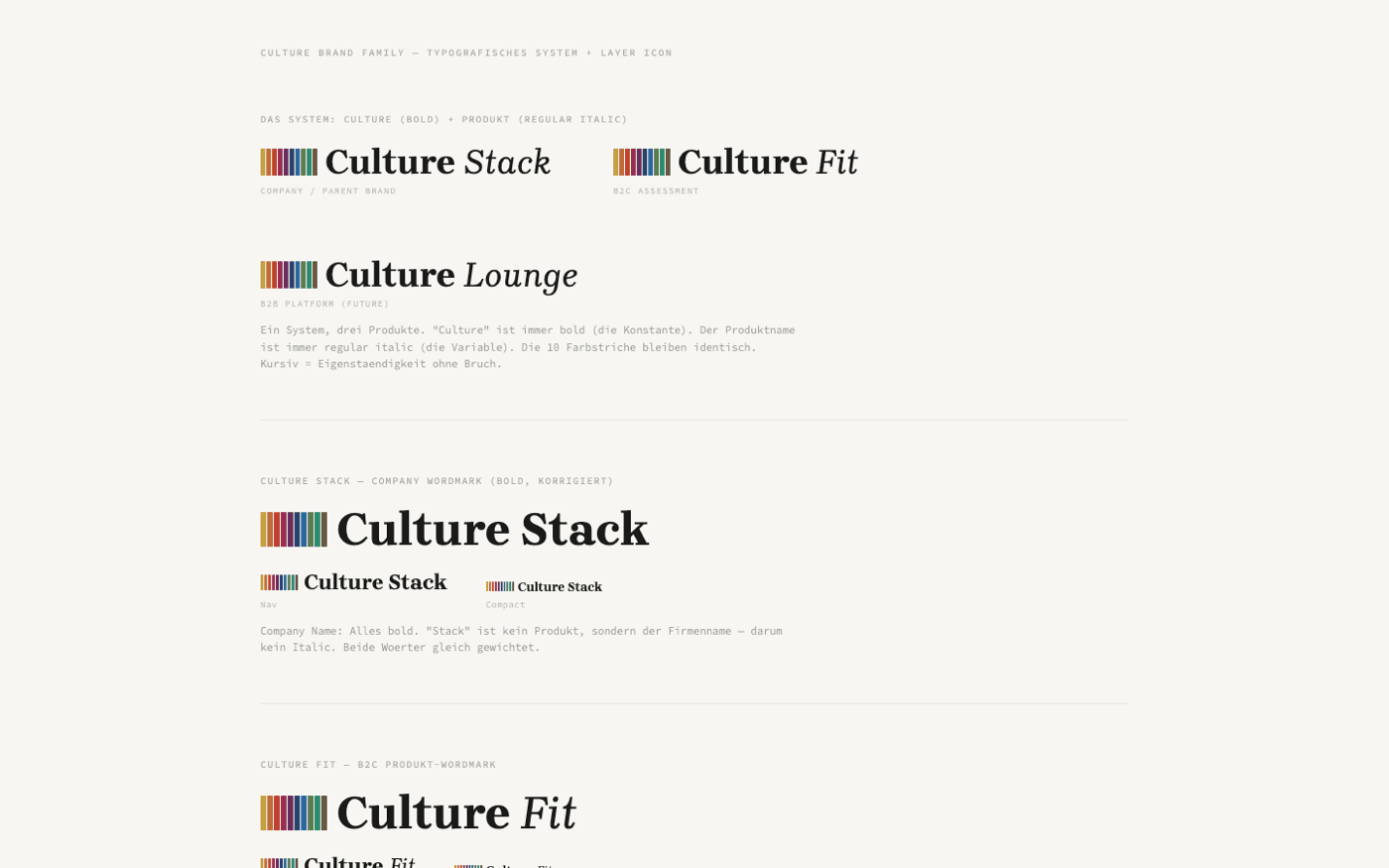
One system. “Culture” in bold, the product name in italics.
- May 11Pivot
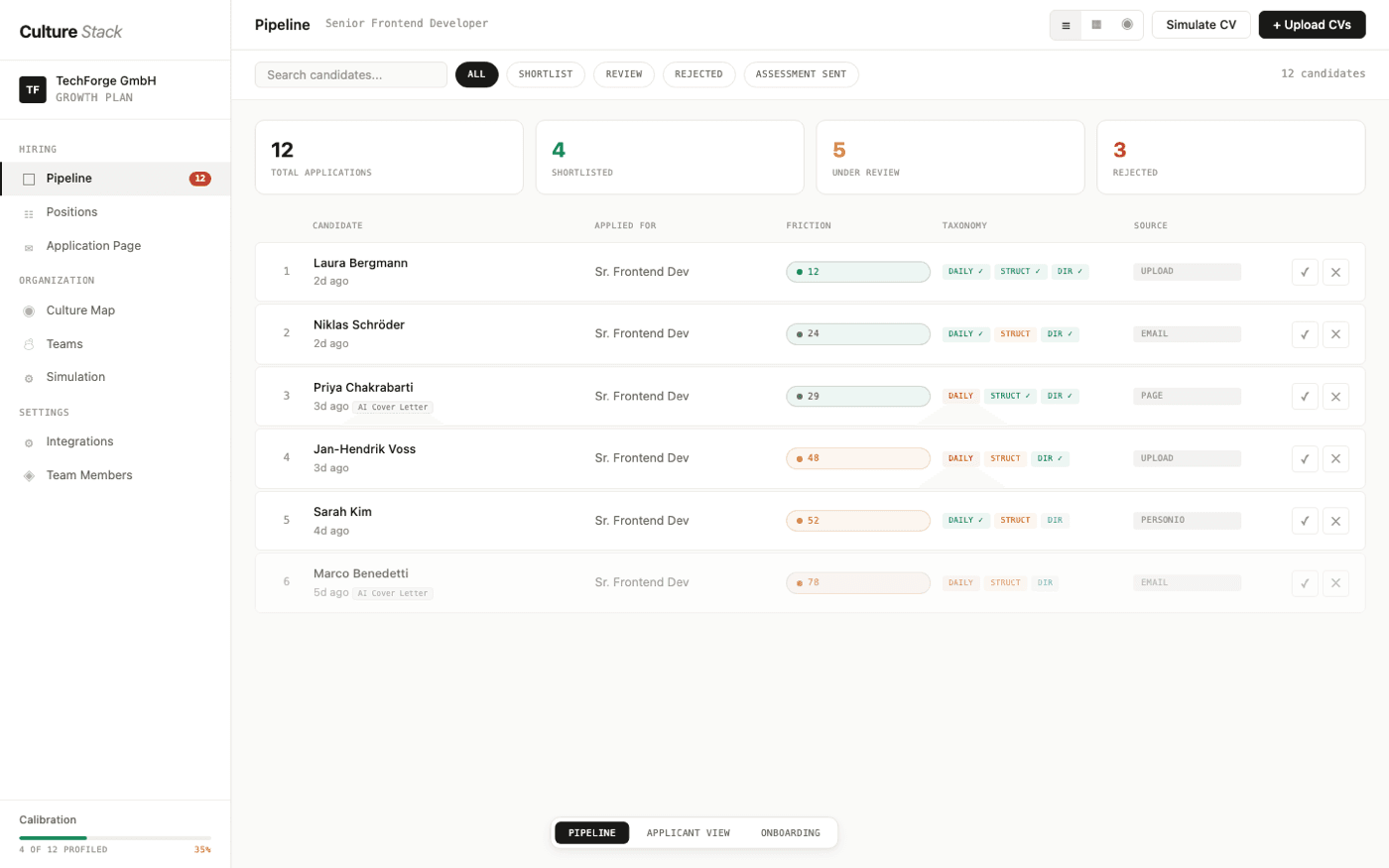
Consumer product killed. 16,100 lines deleted. The first business version was a dashboard.
- May 30First user
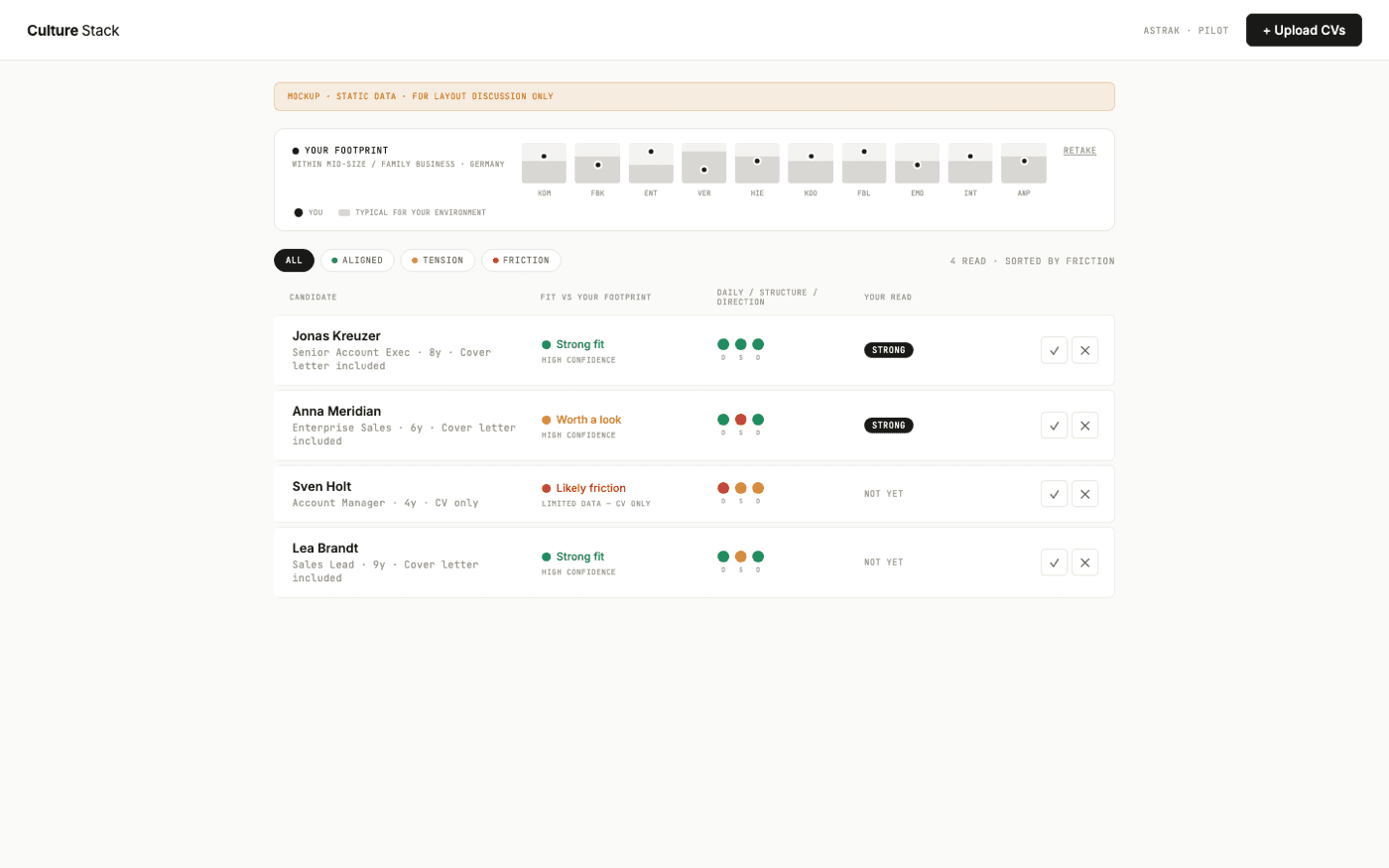
Pilot. The team’s profile on top, candidates sorted by friction. A real client tested it on his own hires.
- Jun 10Turn
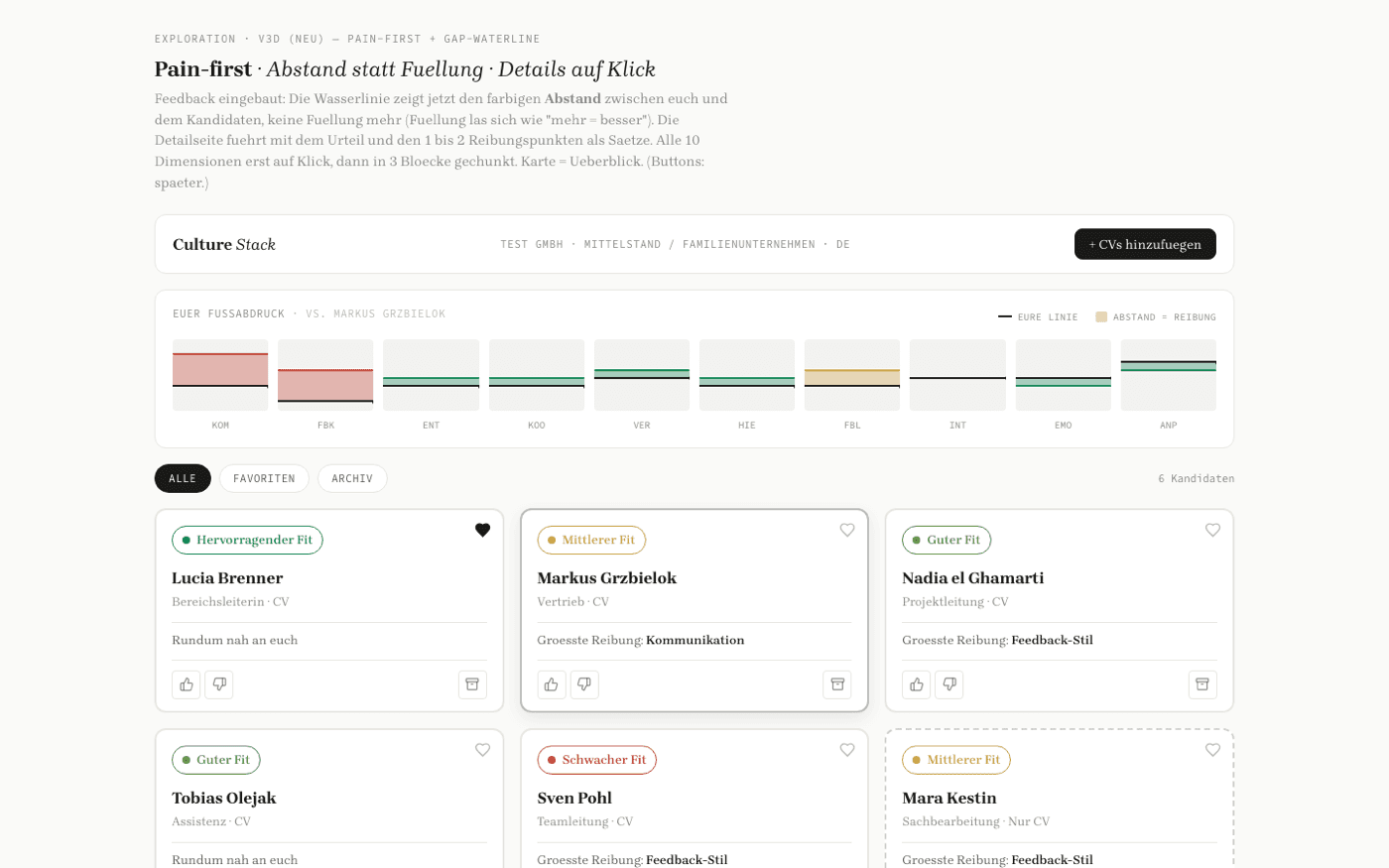
Pain-first. Colour only the gap between team and candidate. Full bars made people think more was better.
- Jun 22Interface
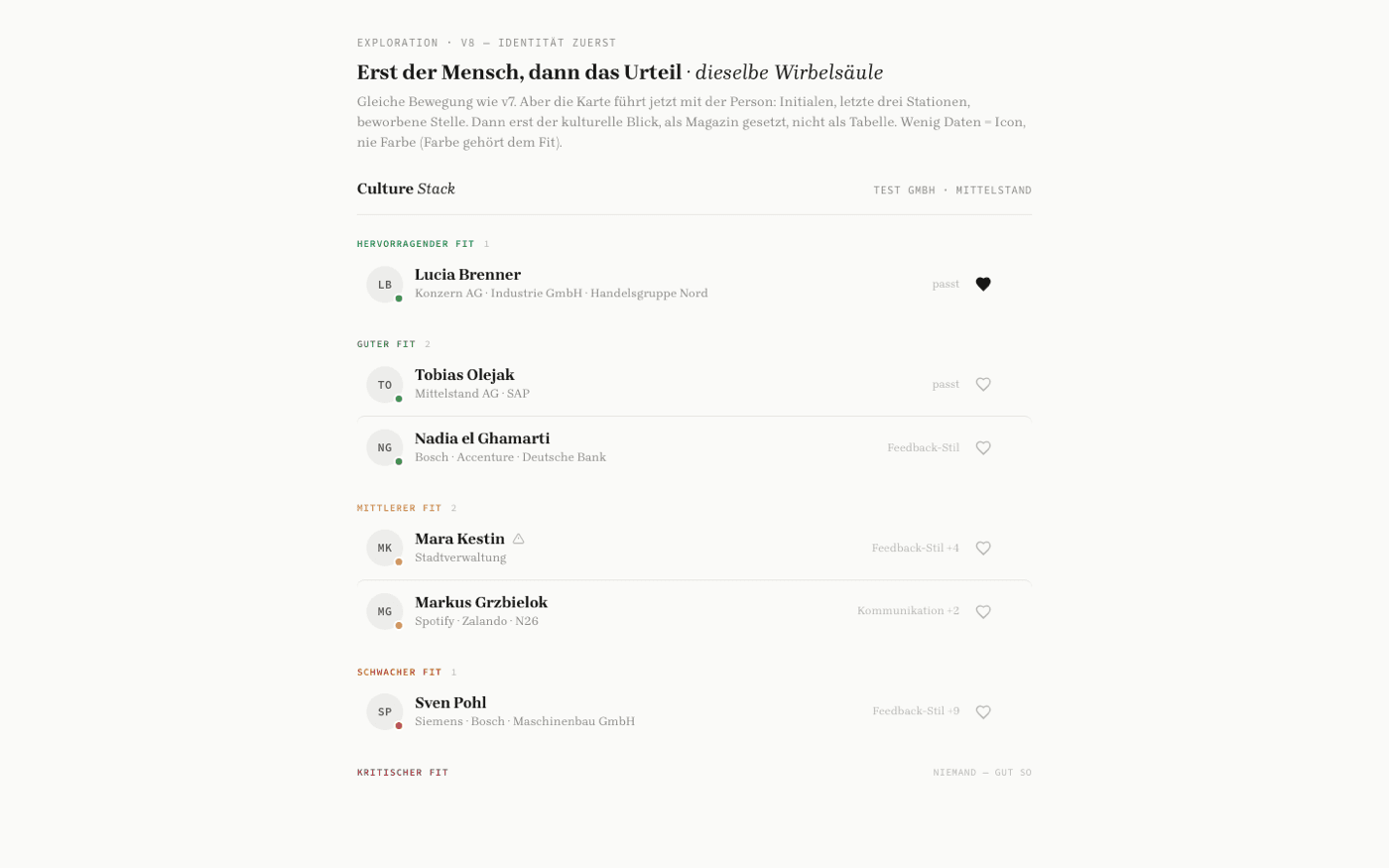
Person first, verdict second. Initials and the last three jobs first, then the culture read.
- Jul 1Map
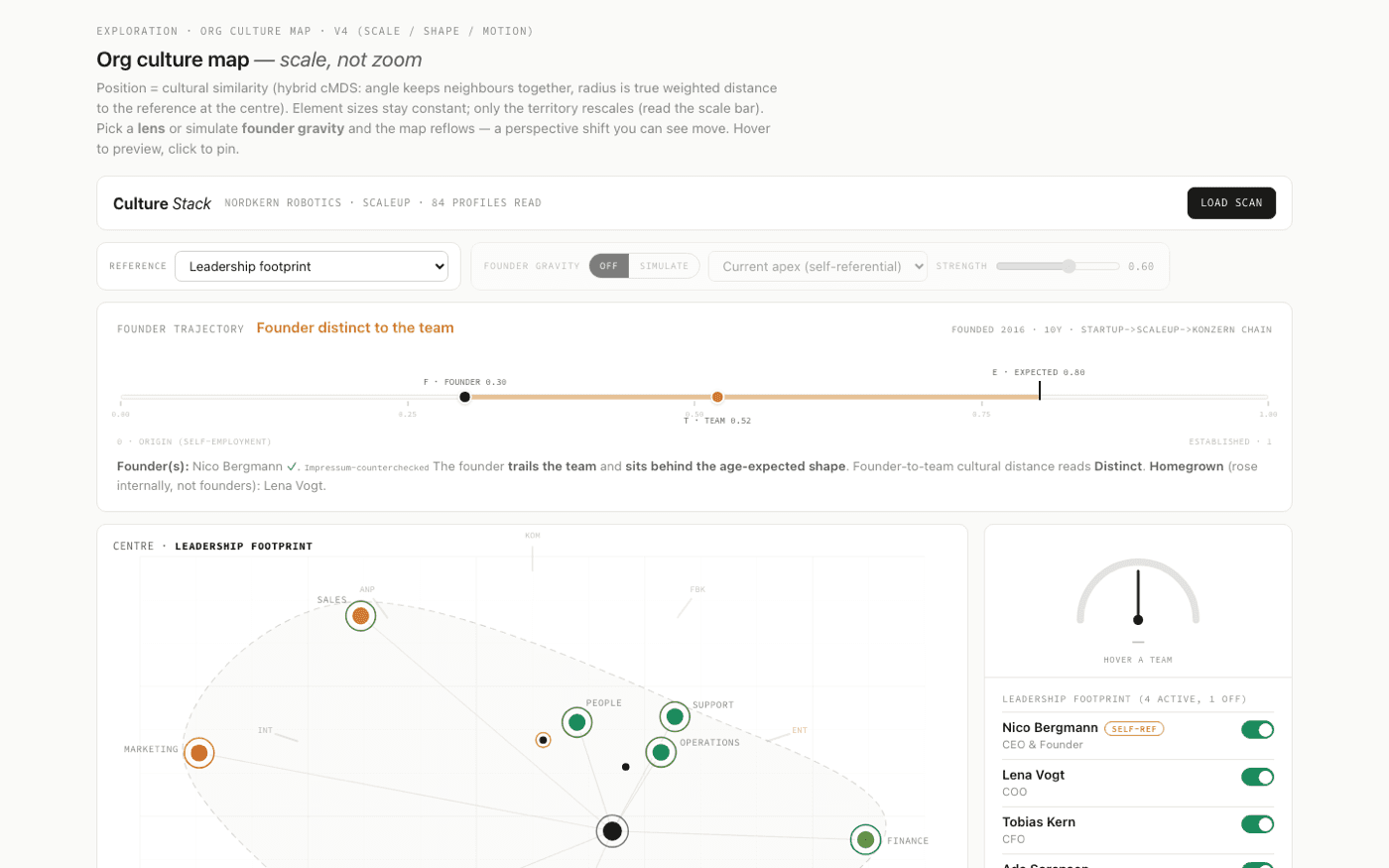
Scale, not zoom. Teams placed by how culturally close they are to leadership.
- Aug 6Trajectory
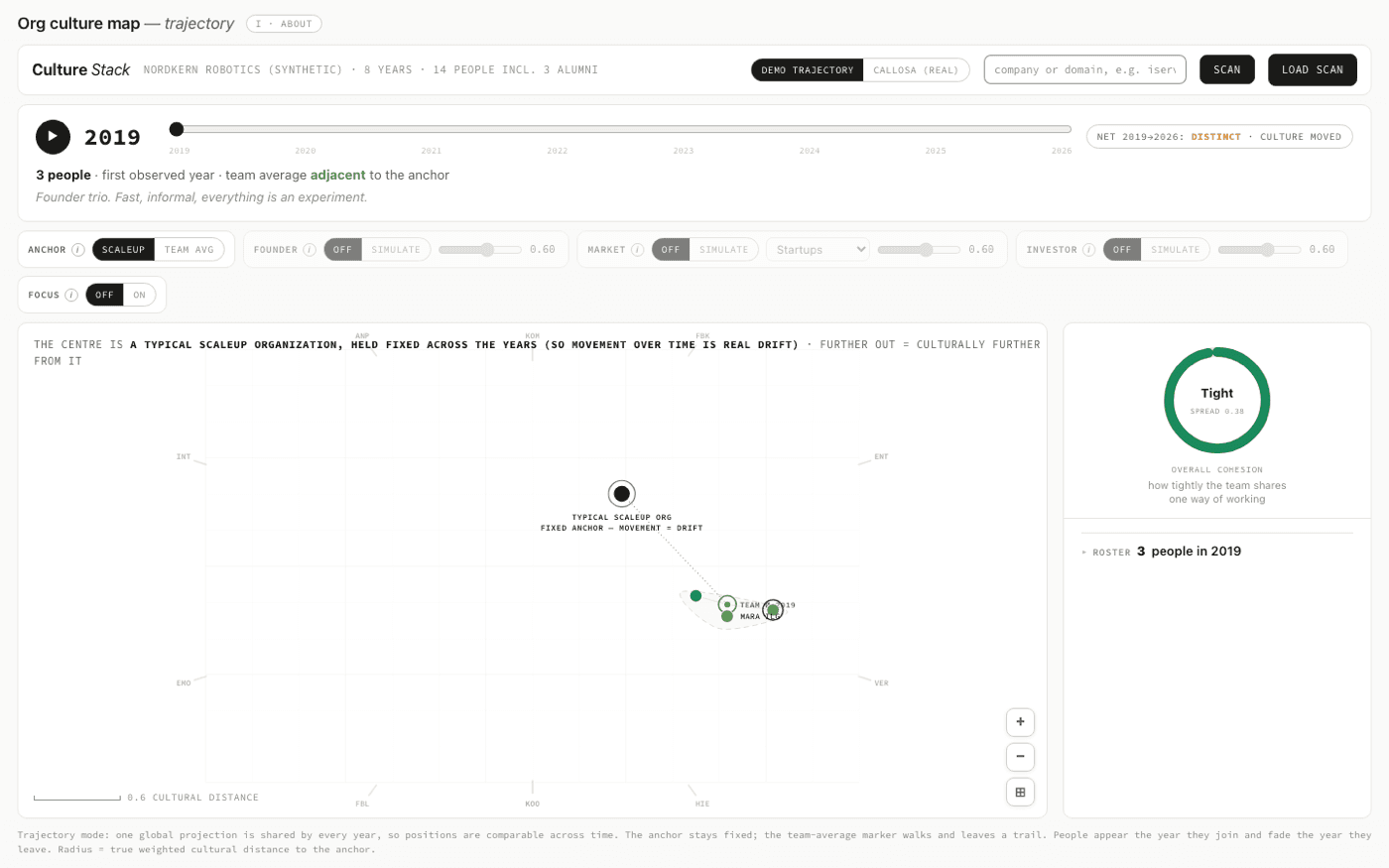
Press play. The map plays year by year. People appear when they join and fade when they leave.
- Aug 10Launch
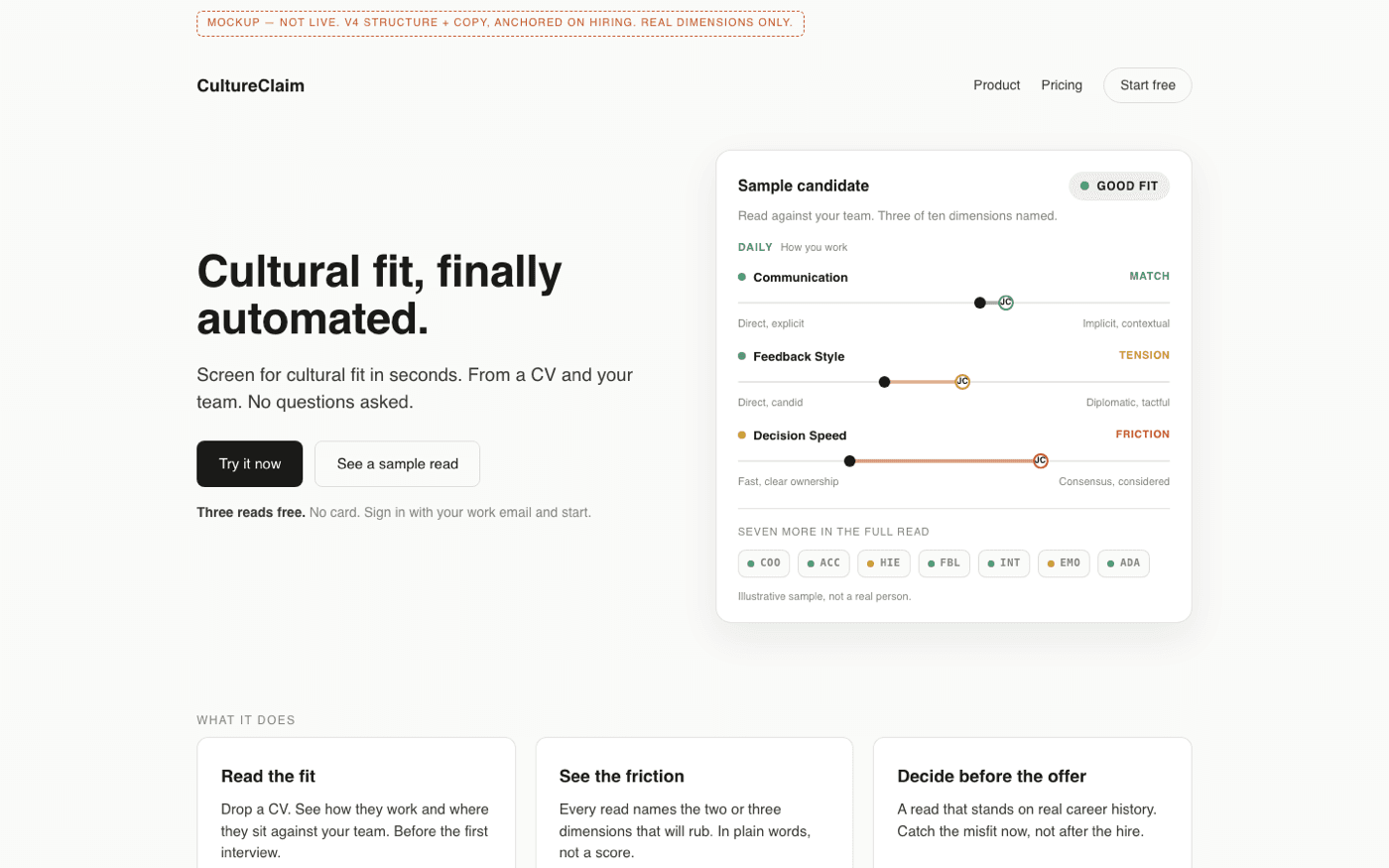
CultureClaim. A self-serve version for the US, on the same engine.
- Aug—SepPMF test
San Francisco. Two months of pitch nights, hackathons and conversations. The demand wasn’t there.
- SepStopped
Error 404: PMF not found. “Doing it was a good decision. So was stopping it.”
Written 11 May 2026, the day the consumer product was cut. Every screen was checked against these four. Original German, with a short English line under each.
Eine Metrik ohne Entscheidung ist Dekoration. Ein Screen ohne nächsten Schritt ist eine Sackgasse. Information die nichts ändert ist Rauschen. Das Produkt misst nicht. Es macht handlungsfähig.
Wie ein Stuhl, eine Maus, ein großer Kameramann. Du bemerkst nicht das Produkt, du bemerkst was es dir ermöglicht.
Menschen sind keine Datenpunkte. Eine Absage ist ein realer Moment. Business-Logik darf scharf sein. Die menschliche Ebene muss warm sein.
Niemand soll sich hilflos fühlen. Jeder Fehlerfall hat einen nächsten Schritt, jede Sackgasse hat einen Ausweg.




Ten stripes for the things nobody writes down.A line for the team, a line for you,and a small coloured space between them:that is where it would have rubbed.Nobody had to take a test.It read what was already there,a careers page, a CV, the trail people leave.It worked. The market didn’t come.He closed it the way you close a good book,finished, and still thinking about it.
The first map was legible and useless. Bubbles around a leadership core, colour for distance, a ring for cohesion — pretty, and nobody could say what to do on Monday. It also implied precision the data did not have.
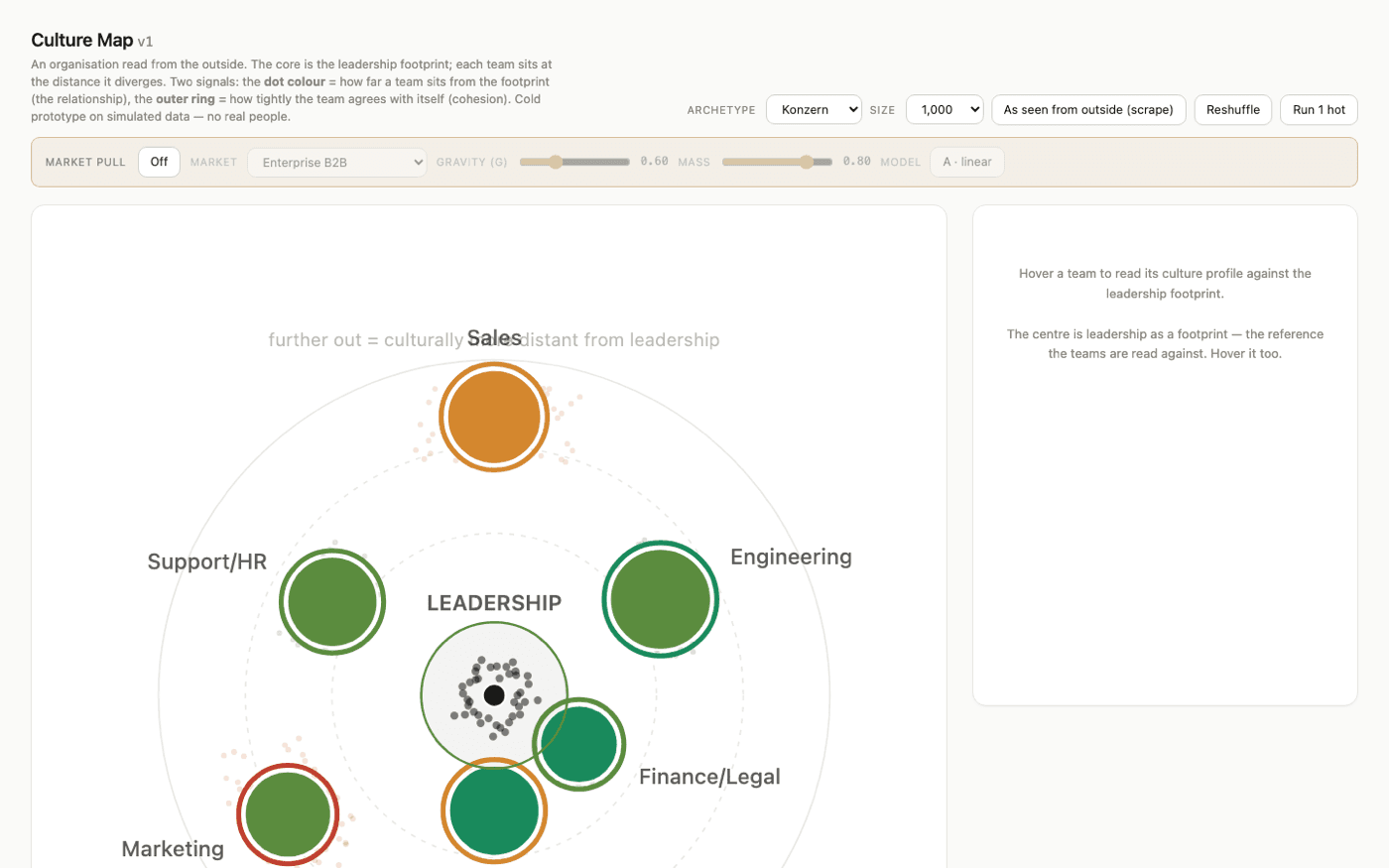
Stop drawing a snapshot; draw movement. Fix the anchor, play the years, let the team average walk and leave a trail. Culture stopped being a diagnosis and became a history you could argue with.
The landing page had to survive a stranger with eight seconds. No score, no chart-as-hero: one sample read, three named dimensions, and the friction stated in words. The product is the sentence, not the graph.
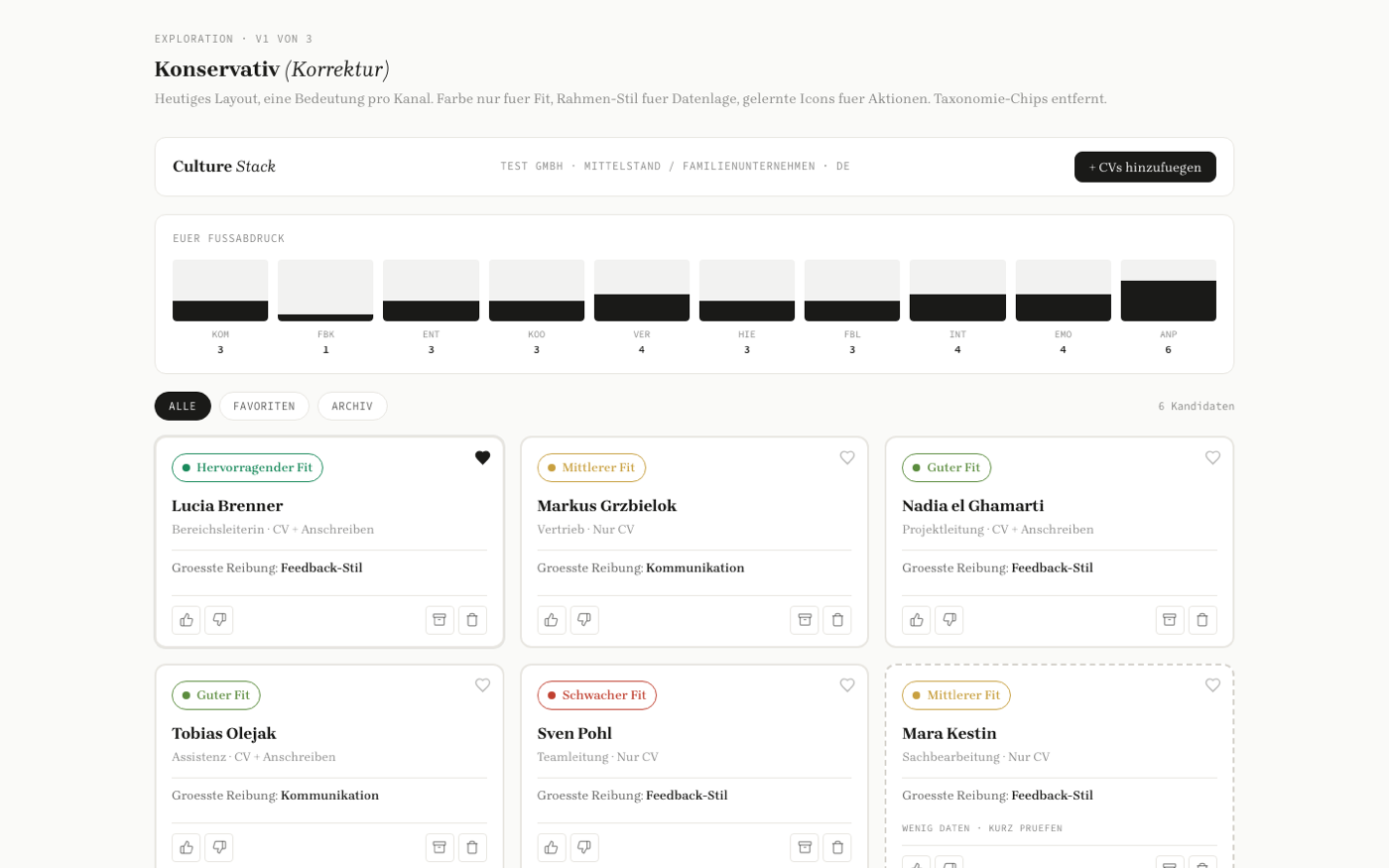
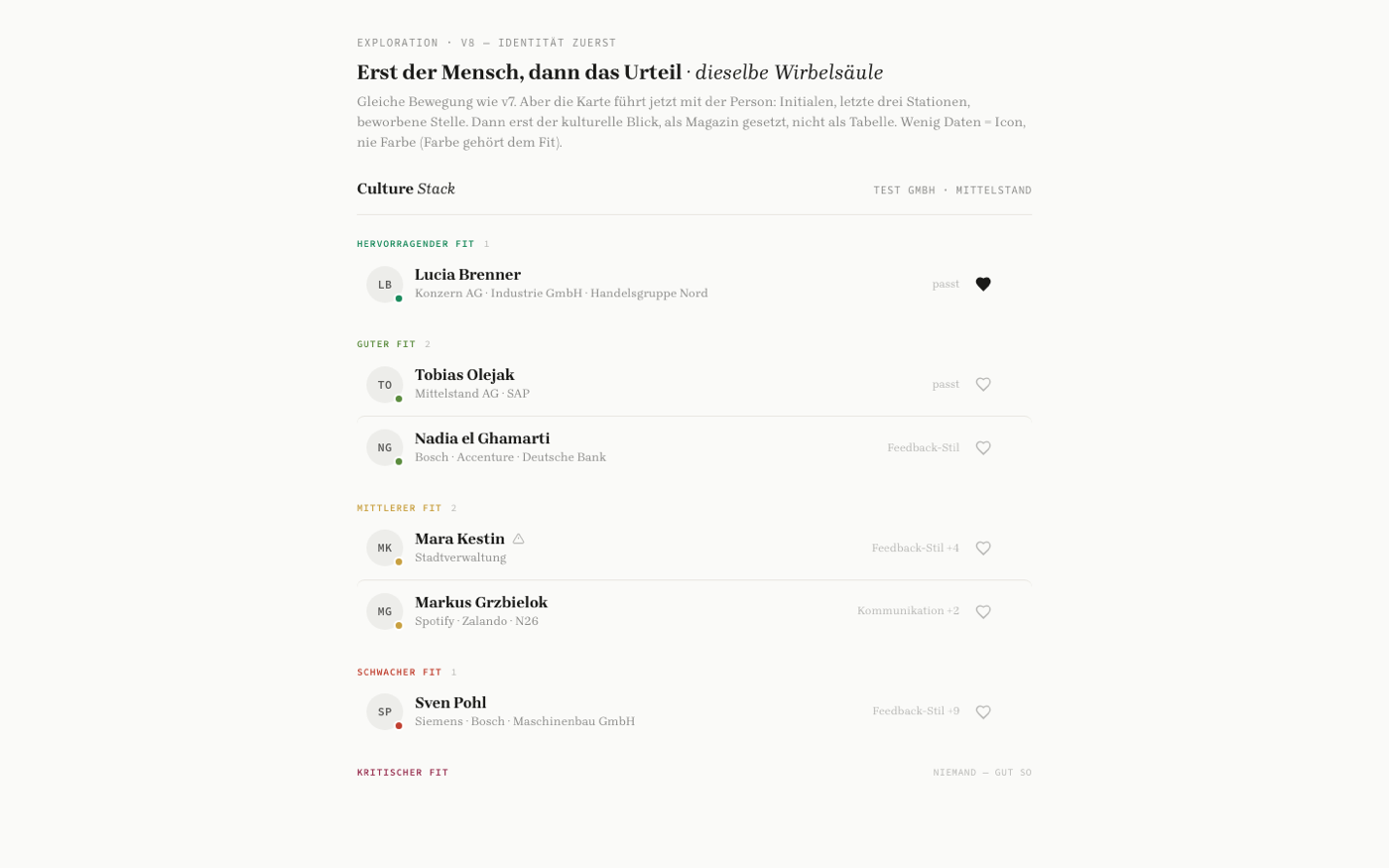
Side by side, v1 read as astrology and v5 read as evidence. The change was not visual polish: it was removing the number and making the reader do the interpretation. Pilot users stopped asking what the score meant and started arguing about the trail, which was the point.
- First commit
- 2026-03-11
- Builds
- 86 · 329 commits
- Surfaces
- culturestack.de · cultureclaim.com
- Pilot
- One engaged user
- State
- Stopped, Sep 2026